Political parody of a famous brand: IKEA v Algemeen Vlaams Belang

An opinion of Advocate General Szpunar, on a case referred to the Court of Justice of the European Union (CJEU), assesses how freedom of expression, under Article 10 (ECHR), interacts with EU trade mark law. The CJEU is set to determine whether political parody or satire can be relied upon as “due cause” in an infringement case and how to balance a conflict between fundamental rights of the same rank, namely freedom of expression and the right to property.
Background
Inter IKEA Systems BV (IKEA), the DIY furniture company, has taken action against a Belgian political party Vlaams Belang for a 2022 political campaign on immigration, which parodied IKEA’s name, logo, and colours, titled “IKEA Plan” (an acronym for “Immigratie Kan Echt Anders”: “Immigration Really Can Be Different”).
The campaign contained 15 “ready to assemble” political proposals, presented in the form of an IKEA assembly instruction manual, which included IKEA’s trade marks in the accompanying illustrations.
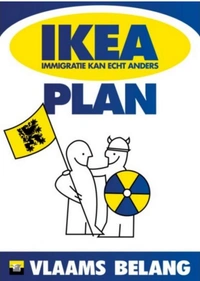
IKEA brought trade mark infringement proceedings in Belgium. The Brussels Enterprise Court referred one question to the CJEU: Can freedom of expression, including the freedom to express political opinions and political parody, constitute “due cause” for using a sign identical or similar to a well-known trade mark? And if so, what criteria should be used to balance the fundamental rights and the importance attached to each of them?
Use in the course of trade
The Advocate General first assessed whether the use complained of constitutes use in the course of trade in relation to goods or services, noting that use in the course of trade can occur by a non-profit entity. The opinion details how political parties receive grants, resulting in an indirect but identifiable link between the campaign and funds received. Whilst a political programme is not, in itself, a good or service; organising an event under the IKEA sign, affixing it to objects distributed to supporters, or using it for advertising may amount to use in relation to goods and services. This remains to be determined by the referring court.
Freedom of expression v intellectual property protection
The core issue is whether use of a famous trade mark, to reinforce a political message, may constitute “due cause”.
The Advocate General notes some reservations on this mechanism, namely that trade mark law is “not the most appropriate for resolving tensions between free political debate and the rights of another person who does not wish to be drawn into the marketplace of ideas”.
However, this is the legal framework which must be applied, concluding that due cause may serve as a mechanism to protect freedom of expression, in the field of trade mark law.
On the relevant criteria for assessment, the Advocate General reinforces the need to strike a balance, which involves subjectively weighing the competing interests and rights of the parties.
A valid justification may exist “where the use of a sign is necessary because of objectively overriding considerations or the subjective interests of a third party, including the economic and commercial relevance of that use”.
The key factor here is whether “the expression at issue contributes to a debate of general interest”. Normally, there is very little scope for imposing restrictions on political speech or matters of general interest; however, the scope can be wider in commercial matters.
Clearly the political campaign itself concerned a subject of legitimate public interest. However, the Advocate General suggested that use of the IKEA marks was not relevant to the political issue and the sign was used by the political party purely to increase the visibility of the campaign. This would not, in itself, be justified by its contribution to the debate on immigration. This is bolstered by the fact that IKEA has never engaged itself in the immigration debate. Therefore, the program does not raise public interest issues which relate to the mark, the proprietor or their goods and services, pulling the use outside the scope of the need for public scrutiny of corporate conduct.
Political parody, under copyright, is use which evokes an existing work, whilst having notable differences from the original; and is humorous or mocking. This will be for the referring court to decide.
The Advocate General concludes that a proprietor of a reputable trade mark cannot be compelled under “due cause” to tolerate infringing use, where the potential contribution to the debate of public interest does not outweigh the fact that it is an attempt to ride the coattails of a sign to promote a political program.
Conclusion
This opinion suggests that freedom of expression cannot be relied upon as a blanket defence under due cause, if the use does not target the proprietor (or their goods/services) and the political programme is simply borrowing a famous mark, for rhetorical effect, to raise visibility for an unrelated political campaign or debate. We await final judgment from the CJEU.
Case details at a glance
Opinion of Advocate General Szpunar
Date: 13 November 2025
Citation: C‑298/23
Parties: Inter IKEA Systems BV v Algemeen Vlaams Belang VZW
Opinion: dycip.com/opinion-c-298-23