Green patent filings: growth hides a shifting global picture

The United States Patent and Trademark Office (USPTO) closed its Climate Change Mitigation Pilot programin 2025. We previously asked whether this closure was signalled a global loss of appetite for green technology. In this article, we revisit that question using a new methodology from WIPO and recent first-filing data.
A new definition for green patenting
There has not been a universally adopted approach to identify “green” filings. In our December 2025 article, Is the appetite for green technology waning? Insights from worldwide patent office statistics, we used Cooperative Patent Classification (CPC) Y02 tags to identify green innovation. However, these tags are harder to search and not as widely used as others.
In August 2026, WIPO published a paper which compared these existing classification systems and methodologies whilst introducing its own new methodology for classifying green technologies: The World Intellectual Property Organization's Green Technology Inventory for Statistical Use (WIPO–GTIS).
When comparing three established methodologies, WIPO’s paper found that together they identified around 2.4 million green patent families in 2021-2023, but only 11.3% of these families were identified by all three methodologies.
WIPO-GTIS uses international patent classification (IPC) codes, which are more widely used than CPC, to group 36 fields of green technology into five sectors:
- Clean energy
- Energy efficiency, conversion and storage
- Sustainable mobility
- Pollution control, recycling, water treatment
- Agriculture, forestry and industry
Using an AI-assisted review of samples of patents and by refining the lists of IPC codes for each field, WIPO produced its concordance workbook, which can be used a methodology for generated custom insights into green filings.
Filing trends using WIPO-GTIS
WIPO’s report uses first filing data until the end of 2023. We used the WIPO-GTIS to extend the analysis to include first filings to the end of 2024; since patent applications typically publish around 18 months after their filing date, this is the last full year of data that is presently available.
Globally, the number of new green patent families increased 7.7% from 2023, to 406,022 in 2024. This also represents an increase of 16.5% since 2020 and 74.1% since 2015. As seen in the chart below, however, first filings in China accounted for 75.6% of new green patent filings in 2024, whilst combined first filings at the other IP5 offices (Japan, South Korea, European Patent Office, USA) fell 7% from 2023 to 2024 due, in the most part, to a 14% reducing in new green patent filings in the USA. This is a stark change from the average decrease of 5.5% each year since 2021. In 2024 the USPTO Climate Change Mitigation Pilot program was still open and Joe Biden was the president, so the continual downturn in green first filings in the USA since 2021 is likely to continue as data from 2025 and 2026 becomes available due to the closure of the USPTO Climate Change Mitigation Pilot program in 2025 and the second Trump administration cutting green technology funding.
Total number of green patent families by first-filing year
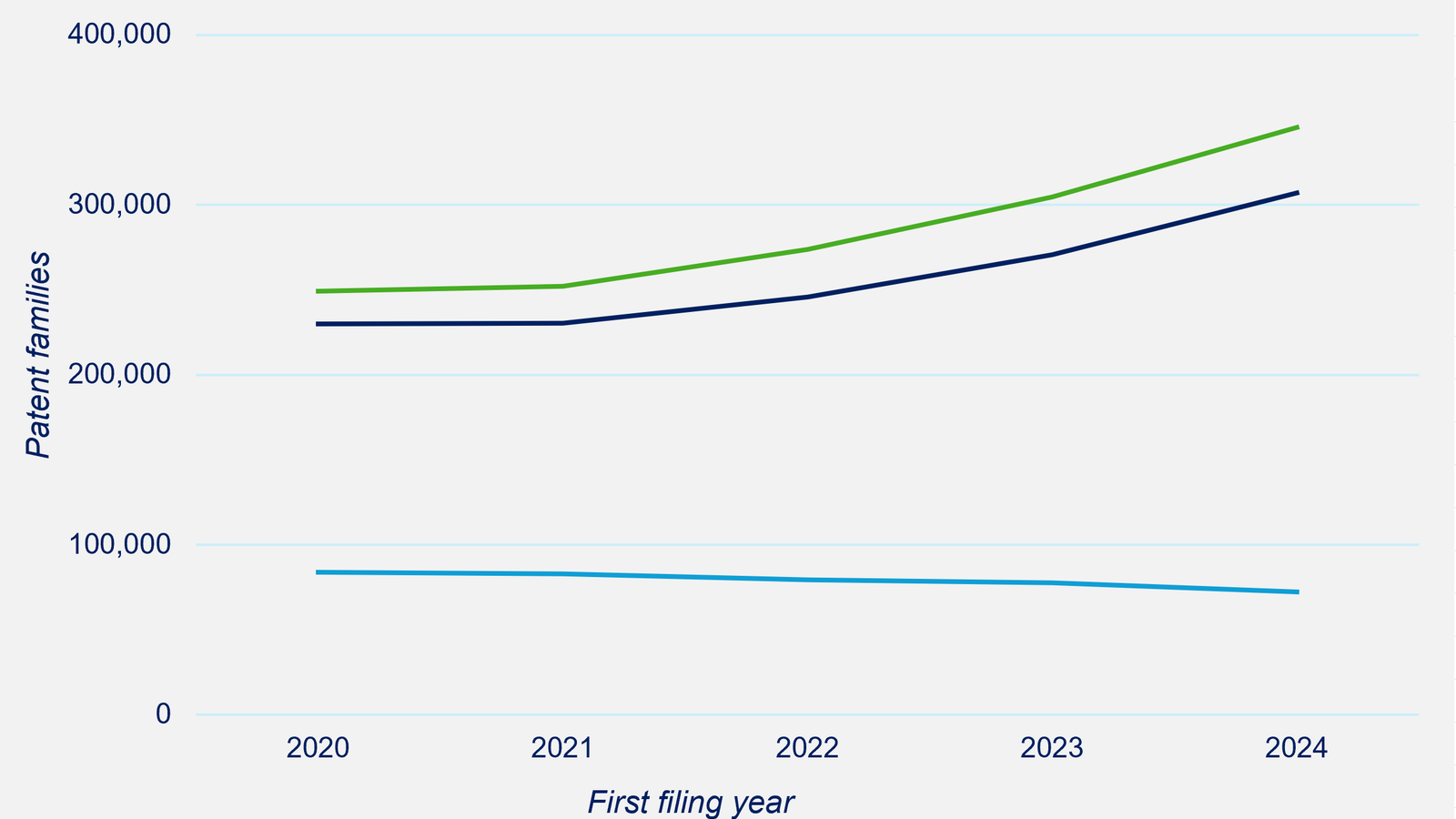
The largest increases in green first filings in China came in smart energy, grid and transmission (23%) and carbon capture and storage (19%), although increases were seen across all the WIPO-GTIS energy sectors. In contrast, the only area where first filings increased in the USA was smart energy, grid and transmission (0.8%).
Japan has also seen a continuous downturn in green patent filings since 2015, but to the same scale as the USA; green first filings reduced by 2.4% in 2024, although this is less than the 3.1% reduction in 2023. More generally, green first filings in Japan have decreased 9% since 2020 and 25% since 2015, although Japan has now overtaken the USA as the second largest patent office for carbon capture and storage filings, after China.
Whilst we previously reported that green first filings at the European Patent Office (EPO) were still increasing year on year, this is no longer the case. 2024 saw a 7% reduction in new green first filings compared to 2023, with even larger reductions in filings in solar energy (-35%), wind energy (-19%) and hydrogen and fuel cells (-12%). In contrast, smart energy, grid and transmission saw a 19% increase in first filings at the EPO, indicating a change in emphasis of green filings at the EPO. The EPO does still have the highest share of green filings compared to all filings at the office at 18%, down from 20% in 2020, compared to 17.5% for China and South Korea, 12% for Japan and 11.3% for the USA. This data, however, is for first filings at the EPO rather than individual national offices. A similar reduction has been seen across the larger national offices in Europe in 2024, with a 4% reduction in the UK, 2% in Germany, 11% in France and 4% in the Netherlands.
With the exception of a 1.2% reduction in 2022, South Korea has seen growth in first green patent filings since 2020, with a 5.1% growth in 2024, with increases in first filings in smart energy, grid and transmission (16%) and hydrogen and fuel cells (9%) countering reductions in first filings in solar energy (-33%) and wind energy (-17%). Korea now has more first green patent filings per year than Japan
Trends within technologies
Smart energy, grid and transmission has consistently seen the largest increase in first filings since 2020; filings have nearly doubled worldwide in the same period. China now accounts for 87% of all smart energy, grid and transmission first filings, but there are a large number of filings in the USA compared to the other areas analysed and this is one of the few areas to still see a growth in new filings in the USA. 61% of this worldwide increase came from two IPC groups; data processing for energy or water supply (G06Q 50/06) and electrical testing and fault location (G01R 31/00). With the rapid increase in renewable energy generation, particularly in China, managing of variable power flows and fault detection becomes vital, hence an increase in filings in this area. In wind energy, the wind-motor subclass (F03D) accounts for around 80% of the growth in filings since 2020; in the same period China’s installed wind capacity nearly doubled, with China now accounting for 76% of all new wind energy filings.
In Korea and Japan, the largest growth in first filings since 2020 has been in carbon capture and storage, where the largest contributor to global growth has been from filings in carbon-oxide separation (B01D 53/62). The largest growth in first filings at the EPO in the same period, however, has been in hydrogen and fuel cells, where water electrolysis was the largest contributor to global growth. This shows different strength of industry and research focus in the different jurisdictions analysed; many green first filings come from universities and SMEs, so the changes in first filing data is a good indicator of where universities are targeting their research.
Although the number of new filings in solar power only rose 3.6% in China in 2024, at the other four offices it fell 33%, resulting in a 9% reduction globally in 2024. It is worth noting, however, that the WIPO-GTIS omits some of the newer photovoltaic IPC groups from its methodology, such as inorganic photovoltaic cells and module groups. With these IPC groups included the reduction in filings in 2024 was only 4%, which is indicative of a shift in the subject matter of the filings.
Outlook
Although the global outlook for green patents is still buoyant thanks to continued growth in China, there are geographic pockets of strength for particular technology areas outside of China. This analysis also looks at first filings to see where innovation is originating, not where the target market is. As described in our December 2025 article, the number of PCT applications for Chinese first filings is still increasing, so there is a growing global outlook for green patent families. Equally, developments in green technology benefit the whole globe, regardless of where the innovation originated.
Related article
Is the appetite for green technology waning? Insights from worldwide patent office statistics, December 2025.
Useful link
WIPO IPC-Green Technology Concordance – A Harmonized Classification Methodology, published 2026: https://dycip.com/wipo-gtis
