Protecting your after-market: part 2 - repairs

Maintenance and repair are essential for prolonging the use of any heavy plant, production line, or farming equipment. Moreover there are often specific components that are more likely to fail than others; for example plastic components may weaken due to prolonged chemical or UV exposure in agritech and construction settings.
There is a general expectation that the owner of a product has a right to repair it, although this can often come up against practical hurdles (for example when trying to repair a phone with glued-down components).
IP law recognises this to an extent; for example, UK design rights include exemptions for elements of an object that must fit or must match other elements to fulfil their purpose, and similarly “where a registered product is a component part of a complex product, it is not an infringement to use that part in repairs to restore the original appearance of the complex product”, all of which helps the spare-parts market.
However, there is a fine line between repairing a product and re-making it, and this is an important distinction for patents because whilst there may be an implied licence to repair, and an exhaustion of patent rights in the sold product, the act of making is a patent infringement per se and the sale of a patented article cannot confer an implied licence to make another one, or exhaust the right of the patentee to prevent others from being made. In other words, the right to repair an old product does not give you the right to make a new one, even from old parts.
How this fine line between repairing and re-making can be found has been explored several times in the courts.
United Wire v Screen Repair Services
In the case of United Wire v Screen Repair Services [2001] RPC 24, United Wire made sifting screens for recycling expensive drilling fluid used in the offshore oil-drilling industry. These screens could accumulate particulates over time, but avoided the problem of clogging by mounting two different filter meshes on a frame with different tensions, so that when the frame was vibrated the meshes responded differently and bashed into each other, helping to dislodge detritus. United Wire’s patent claimed the screen as a frame with the meshes secured to it having differential tensions.
The meshes often became torn in use, and could not easily be patched. As a result there was a profitable aftermarket for United Wire in replacement screens. Screen Repair Services chose to compete in this market by selling reconditioned screens made with United Wire’s frames and new filter meshes.
Lord Hoffmann noted in this case, “As a matter of ordinary language, the notions of making and repair may well overlap. But for the purposes of the statute, they are mutually exclusive”, for the reason that making is a patent infringement per se as mentioned above.
In the present case, it was considered fairly clear that the defendants had made the patented product. They had repaired or reconditioned the frame, and then used that frame to make a screen as claimed with new meshes, in exactly the same way as if they had bought the frames as components from a third party.
In the judgment, it was stated that “the screen was the combination of frame and meshes pre-tensioned by attachment with adhesive according to the invention. That product ceased to exist when the meshes were removed and the frame stripped down to the bare metal. What remained at that stage was merely an important component, a skeleton or chassis, from which a new screen could be made”.
So this case established that it was more important to ask if the product was being made than if it was being repaired, given that these concepts could overlap in real life but not in law, but the facts of the case left little room for nuance. Subsequently however, this issue was revisited in Schütz v Werit [2013] UKSC 16.
Schütz v Werit
The case of Schütz related to an intermediate bulk container “IBC” that is essentially a plastic bottle in a steel cage, such as the one shown below, and commonly used in agriculture, construction, and liquid delivery. These IBCs can withstand 1000 litres of liquid sloshing without buckling, cracking, or leaking, and can handle six tonnes when stacked.
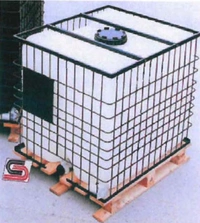
Despite being tough, often however the bottle cannot be reused; for example if it contains toxic residue from a previous load. Even if it can be reused, the cage typically has a longer (5-6x) lifespan than the bottle itself.
So here the bottle is not a wholly subsidiary consumable component (like a coffee pod in a coffee machine), and is essential to the formation of the claimed IBC. However, as a general principle there is clearly a question of degree and a case-by-case threshold for this distinction. As the final judgment put it, “the bottle can fairly be said to be a relatively subsidiary part of the article, viewed as a whole”, for example due to the lower life expectancy of the bottle and its being made of plastic rather than metal. Put another way, given the cage has a much greater life expectancy than the bottle, a purchaser of an IBC might well expect to be able to replace the bottle even though it is not a conventional “consumable” of the IBC.
Consequently there is a market for replacing old bottles and repairing any damage to the cage. Here, “rebottling” uses original equipment manufacturer (OEM) bottles from Schütz, whilst “cross-bottling” uses bottles from a different source. In this case, Werit was reconditioning Schütz IBCs using bottles from a different source; “Delta”.
However Schütz was concerned not just with price competition but also scope for reputational damage if other less reliable bottles were used in an ostensibly Schütz IBC.
Much like United Wire’s patent to a complete screen made of a frame and mesh filters, Schütz’s patent was directed to a complete IBC made of a cage and bottle. Again, the part at issue was the one that required regular replacement.
One notable difference however was that the inventive aspect of the IBC claim related to flexible weld joints in the cage to increase its strength and durability. Hence the part being reconditioned was not the part conferring the inventive step, contrary to the case in United Wire.
As noted in the final judgment, “In this case, the replaced part, the bottle, is a free-standing item of property, which does not include, or relate to, the inventive concept. In United Wire, the replaced part, the wire mesh system, had no independent identity from the retained part, the frame”.
Hence whilst in United Wire it was possible to say that the original “product ceased to exist when the meshes were removed”, it has held “in this case there are, as it were, two products […], and one of them, which is significantly longer lasting, more substantial, and the only inventive component, certainly does not cease to exist”.
As a result, it was held that replacing the bottle, and doing no more than routine repairs to the cage, did not constitute making the patented article.
We can take from this that whilst one can repair a patented article, this does not extend to the point at which one makes or re-builds the product of the invention per se. In the case of United Wire, this happened when new meshes were added to old frames as the meshes conferred the inventive step and were instrumental in creating benefit of the patented screens, whereas it did not happen in Schütz when new bottles were added to old cages, because the inventive step resided in the cages and adding a different make of bottle was not instrumental to increasing the strength and durability of the cage welds.
Meanwhile the third scenario, where the inventive step resides in how two components interact, is a separate question in part answered by the earlier article in this short series, focusing on consumables, and in part answered by the final article in the series, focussing on plug-and-socket (or transmitter-and-receiver) type inventions.
Cases cited in this article
- United Wire Limited v Screen Repair Services (Scotland) Limited and Another and Others, 20 July 2000: dycip.com/united-wire-screen-repair
- Schütz (UK) Limited v Werit (UK) Limited, 13 March 2013 (PDF): dycip.com/schutz-werit
